
How to Build a Core Portfolio in 2026
- Details
On March 9, 2026, the Indian markets lost ₹13.5 lakh crore in a single day. The same screen was being viewed by two different investors. During the decline, one set of investors was able to square off their gold investment, maintain SIPs, and use idle debt as leverage to buy equity. The other set of investors lost money that may take months to recover after circuit breakers and selling close to the bottom.
Neither superior intelligence nor sharper instincts made a difference. It was a structure built prior to the noise. This framework is applicable not only in this market but also in the next and all subsequent markets.
What Is Actually Happening and Why?
This is not a crash. The first step in avoiding costly decisions based on fear is to identify the three distinct, identifiable causes of this correction.
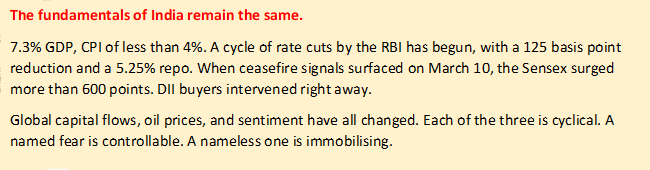
Geopolitics is the primary cause. Brent crude surpassed $115 per barrel due to the US-Iran-Israel dispute. 85% of India's oil is imported, which increases the country's current account deficit, drives up inflation, and weakens the rupee. That pressure showed up clearly on March 24, when the INR weakened to a record low of ₹93.88 against the dollar. Actual strain. History, however, offers some useful perspective. The World Bank’s Commodity Markets Outlook, which tracks oil price movements across major geopolitical events since 1973, from the Gulf War to the Russia–Ukraine conflict and multiple Middle East flare-ups, shows a consistent pattern: sharp, conflict-driven spikes in crude tend to reverse within a few months once tensions ease.
Foreign capital comes in second. In 2025, FIIs pulled out a record ₹1,66,283 crore from Indian equities. That trend has continued into 2026, with net selling of ₹97,195 crore in March alone up to the 23rd. The reason is that dollar assets are more appealing than emerging market stocks due to rising US Treasury yields. When US yields stabilise, FIIs come back. They have consistently done so.
Valuation comes in third. 2026 saw stretched multiples in the Indian markets. The Nifty PE is now about 21.4x healthier but not inexpensive after the correction. This is not a signal to buy everything. It's a selective one.
Before Allocating a Single Rupee, Ask These Seven Questions
Before working with a single instrument, each portfolio manager creates an Investment Policy Statement. It responds to enquiries about you rather than the market. RRTTLLU is the name of the professional framework. It is far more important than any choice you will ever make about a fund.
This is why it is so urgent: your equity allocation is higher than your real risk tolerance if a 10% correction is keeping you up at night. There was nothing wrong with the market. The distribution did. If you honestly answer these seven questions, it won't happen again.
Return Objective: What annual return do you actually need to reach your goal? Not the highest possible return, but a clear number. For example, turning ₹30 lakh into ₹2 crore over 15 years requires roughly a 13 per cent CAGR. That figure should guide how much equity you hold in your portfolio. The common trap is chasing returns that are higher than what your goal actually requires.
Risk Tolerance: Risk tolerance has two separate components. Ability and willingness. Ability depends on factors like income stability, liabilities, and dependents. Willingness reflects how comfortable you feel when markets fall, for example, during a 10 percent correction. Moments like March 2026 reveal your real willingness, not the theoretical one you assumed earlier.
Trap: Assuming that a steady income automatically means you can handle a 30% market drawdown. The two are not the same.
Time Horizon: Less than 3 years, no equity because there may not be enough time for markets to recover if they fall further. A horizon of 3 to 7 years should generally have a balanced allocation. A horizon of 7 years or more can support an equity-heavy portfolio. What matters most is your goal date, not your age. A 60-year-old with a 20-year retirement horizon can still hold equity. A 30-year-old planning to buy a home in two years cannot.
Trap: Using age as a proxy for time horizon.
Taxes: Equity long-term capital gains are taxed at 12.5 per cent after 12 months. Debt mutual funds purchased after April 1, 2023, are taxed at slab rate regardless of how long they are held. Arbitrage funds are taxed as equity but usually generate returns similar to debt, which creates a meaningful post-tax advantage for investors in the 30 per cent tax bracket.
Trap: Choosing instruments before calculating post-tax returns.
Liquidity: Think of liquidity as a ladder. Cash > Liquid mutual funds > Fixed deposits > Equity mutual funds > Gold ETFs > REIT or InvIT > Sovereign Gold Bonds > Real estate > AIF or PMS. Your emergency fund, equal to about six months of expenses, should sit at the top of this ladder. It should never be invested in equity.
Trap: Putting emergency money into equity because it grows faster and then being forced to sell during a market decline when a life event occurs.
Legal and Regulatory: NRI status may restrict access to certain mutual fund categories. Directors of listed companies must follow trading window rules. HUFs and family trusts may face different tax treatment even when investing in the same instruments.
Trap: Discovering these limitations only after the investment has already been made.
Unique Circumstances: Concentrated ESOP holdings can significantly change how your equity exposure should be structured. Irregular business income may require a larger liquidity buffer. Inherited wealth can also alter both the time horizon and the emotional relationship someone has with capital.
Trap: Applying a standard retail investment template to a situation that is not standard.

What Each Asset Class Is Really For
Every asset in a portfolio should have a clear purpose. If you cannot explain the role it plays, it probably does not belong in the portfolio.
Equity
Equity is the only asset class that has consistently built wealth over long periods, especially beyond seven years. Declines of 20 to 40 per cent are normal and part of the process, not a flaw. Investors accept this volatility in exchange for long-term compounding.
If you interrupt that process by selling during market corrections or stopping your SIPs, you weaken the compounding engine you originally set up.
Core equity exposure can be built around a Nifty 50 index ETF because it is low cost, tax efficient, and removes fund manager risk. It can be complemented with one flexi-cap fund that can shift between large-, mid-, and small-cap stocks depending on market conditions.
Ideally keep no more than three equity funds. Beyond that, most portfolios start to overlap rather than diversify. Many funds end up holding the same Nifty stocks, meaning investors pay several expense ratios for essentially the same exposure.
During market corrections, SIPs should continue. A lower NAV simply means every instalment buys more units. That is the system working as intended.
Debt
Debt is not included in a portfolio just for safety. It serves two important purposes that equity cannot provide. First, it offers stability during market drawdowns. Second, it acts as dry powder. This is capital that can be deployed into equity when markets fall.
Without a debt allocation, corrections become something investors watch rather than an opportunity they can use. In 2026, suitable options include short to medium duration AAA bond funds and dynamic bond funds. The RBI has already reduced interest rates by 125 basis points, and much of the benefit has already been captured by long-duration government bonds.
For investors in the 30 per cent tax bracket, arbitrage funds may be more tax efficient than traditional debt mutual funds because they are taxed like equity while generating returns similar to debt.
Another important point is that debt mutual funds purchased after April 1, 2023, are taxed at slab rate regardless of holding period. This should be considered when choosing instruments.
Gold
Gold acts as insurance in a portfolio. Its value comes from moving differently than equities. It often rises when stock markets fall, currencies weaken, or geopolitical uncertainty increases.
Gold delivered about 72 per cent returns in INR during 2025. Since hitting record highs in January 2026, prices have eased somewhat. A stronger US dollar and rising Treasury yields have created headwinds, but the decline hasn’t been steep. Ongoing geopolitical tensions and a weaker rupee have continued to support prices, preventing a sharper correction. The World Gold Council views this as a sign of softer near-term demand, even though the longer-term case for holding gold remains firmly in place.
Gold ETFs are generally the preferred vehicle today. New sovereign gold bond issuances have been discontinued, recent budget changes removed capital gains benefits for secondary market SGB buyers, and digital gold remains outside SEBI and RBI regulation.
Mutual Funds
Mutual funds are not an asset class by themselves. They are simply a structure used to access assets such as equity, debt, gold, or real estate within a regulated framework.
A common mistake investors make is treating fund selection as the most important decision. In reality it should be the final step. The correct sequence is goal first, then time horizon, then fund category, and only then the specific fund. Many investors do the opposite. If someone owns twelve mutual funds, it is very likely that most of them hold the same large-cap stocks from the Nifty 50. That means the investor is paying multiple expense ratios for essentially the same exposure.
Real Estate
Your home is primarily a life decision rather than a portfolio allocation. It cannot be partially sold to rebalance a portfolio, and it cannot be exited quickly. Including the market value of your home in your investable portfolio can make the portfolio appear diversified on paper while remaining illiquid in reality.
For investors seeking real estate exposure as a financial asset, listed REITs provide access to Grade A commercial properties without requiring large capital commitments. Examples include Embassy, Mindspace, Brookfield, and Nexus Select. Units typically trade between about ₹100 and ₹400 on the stock exchange. InvITs provide exposure to infrastructure assets such as highways and power transmission networks.
The Nifty REITs and InvITs Index returned about 25.48 per cent in FY2025 and has relatively low correlation with the Nifty. A typical allocation is around 5 to 10 per cent of the portfolio, and it mainly acts as an income stabiliser rather than a growth driver.
The most expensive portfolio mistake is often not choosing the wrong fund. It is owning an asset without clearly understanding the role it is supposed to play in the portfolio.
Mutual Funds: Choosing the Right Category
On February 26, 2026, SEBI released a revised mutual fund categorisation circular that introduced several important changes. The number of equity categories increased from 11 to 13. Thematic funds and sector funds are now clearly separated.
A new category called 'Life Cycle Funds' has also been introduced. These funds gradually shift allocation from equity to debt as investors move closer to their goal date. The structure is similar to target date funds used globally and represents one of the most investor-friendly structural changes in the Indian mutual fund industry in many years.
The right sequence is category before fund and goal before category. A simple decision map can help guide the process.
|
Goal / Horizon |
Right Category |
What to Avoid |
|
Under 3 years |
Liquid funds or money market funds that prioritise capital protection and quick redemption. |
Any equity fund and medium- or long-duration debt funds. |
|
3 to 7 years |
Dynamic bond funds combined with hybrid funds. Arbitrage funds may also work well for investors in the 30 per cent tax bracket. |
Thematic funds and small-cap funds because they can be too volatile for this time frame. |
|
7+ years core |
Nifty 50 index ETF as the anchor along with one flexi-cap fund. Life cycle funds can also work well for goal-based investing. |
Sector funds as core holdings and holding more than four funds in total. |
|
Satellite max 10% |
Thematic or sector funds only when there is a clear and time-bound investment thesis. |
New fund offers launched at the peak of sector excitement and then treated as long-term investments. |
Three Portfolios, Same Market, Three Right Answers
The same market conditions call for different responses depending on the investor's actual risk profile. The portfolios below are organised by risk appetite.
|
|
Capital Preservation |
Balanced Growth |
Long-Term Growth |
|
Risk profile |
Low drawdown tolerance. Near-term liquidity needs. Income from portfolio required. |
Moderate tolerance. 5–10 year horizon. Can absorb 15–20% drawdowns. |
High tolerance. 10+ year horizon. Stable income. Can absorb 30%+ drawdowns without intervening. |
|
Equity |
25-30% in a Nifty 50 ETF |
50-55% using a mix of ETF, flexi-cap, and limited mid-cap exposure |
65-70% using ETF, flexi-cap, and one mid-cap fund |
|
Debt |
40-45% in short-duration and AAA corporate bond funds |
25-30% in dynamic bond funds and AAA corporate bond funds |
15% in arbitrage funds |
|
Gold |
15% in gold ETF |
15% in gold ETF |
10% in gold ETF |
|
REITs / InvITs |
15% in listed REITs |
5% in listed REITs |
5% optional allocation |
|
Alternatives |
None |
None unless investable assets exceed Rs 50 lakh |
PMS when investable assets exceed Rs 50 lakh and AIF when assets exceed Rs 1 crore |
Five Things to Do This Month
1. Check your gold allocation. After the 72 per cent rally, many investors are now sitting at 20 to 25 per cent exposure without intentionally increasing it. The World Gold Council's Sharpe ratio analysis of Indian portfolios shows that gold's diversification benefit is strongest in the 10 to 15 per cent allocation range. Beyond that, it functions as a return driver rather than a hedge, which changes the risk character of the portfolio. If your allocation is above 15 per cent, consider trimming it and reallocating the excess to the asset class that is currently underweight in your portfolio.
2. Do not stop your SIPs. A lower NAV simply means each instalment now buys more units than it did earlier. That is exactly how the system is designed to work. Pausing SIPs during market declines is one of the most expensive mistakes retail investors make.
3. While the recent correction is still fresh in your mind, it’s worth stepping back and honestly answering the RRTTLLU questions. If the current volatility has felt more uncomfortable than expected, that’s usually a sign that your equity allocation is higher than what you’re truly willing to handle. Rebalancing during a correction has a clear practical edge. When you shift money back into equity at lower prices, you’re restoring your intended allocation at a time when it can work more effectively for you. That said, waiting until markets stabilise isn’t a mistake; it just means you miss out on that timing advantage. What matters more is that you rebalance at all. Taking action, even slightly later, is far better than doing nothing.
4. Review the tax treatment of your debt mutual funds. Debt funds purchased after April 1, 2023, are taxed at slab rate regardless of holding period. Compare the post-tax return with arbitrage funds because for investors in the 30 per cent tax bracket, the annual difference can often be around 1 to 1.5 percentage points.
5. If you have Rs 50 lakh or more in investable assets, discuss PMS with your advisor. This does not mean mutual funds are incorrect. Direct stock ownership in your demat account can provide greater transparency and allow tax personalisation that pooled vehicles cannot offer. Focus on the five-year track record and maximum drawdown rather than the best single-year return.
Build It Now. Then Leave It Alone.
Investors who navigated the volatility of 2020, 2022, and March 2026 successfully were not necessarily better informed. They had built a framework before the volatility arrived. Every asset had a defined role, the portfolio had a review schedule, and the plan was followed with discipline. That is the real advantage.
Answer the seven questions. Assign every rupee a purpose. Review the portfolio once a year and rebalance gradually through new contributions whenever possible. When the next correction inevitably arrives, you will see that the only lasting edge is a plan built during calm periods.
Sources & References
All factual statements were verified using the following sources.
SEBI New Mutual Fund Categorisation Circular | SEBIUsed for: expansion to 13 equity categories, introduction of life cycle funds, separation of thematic and sectoral funds, 50 per cent overlap cap, true-to-label mandate, and ELSS renaming.
Portfolio Planning: RRTTLLU (CFA Level 1) | CFA InstituteUsed for: Investment Policy Statement construction, risk tolerance components, and time horizon frameworks used in professional portfolio management.
FII and DII Activity March 2026 Month-to-Date Flows | NSE India
Used for: FII MTD net sell ₹97,195 crore; DII MTD net buy ₹1,13,202 crore through March 23, 2026; March 23 FII sell ₹10,414 croreMonetary Policy Report | Reserve Bank of India
Used for: Repo rate at 5.25% (125 bps reduction); GDP growth projection 7.3% FY2026; CPI inflation below 4% targetCapital Gains Taxation Section 112A and 111A | Central Board of Direct Taxes
Used for: Section 112A: LTCG at 12.5% after 12 months on listed equity; Section 111A: STCG at 20%; debt MF slab rate post April 2023REIT and InvIT Regulations | Securities and Exchange Board of India
Used for: REIT reclassification as equity instruments for MF participation from January 1, 2026Why Gold in 2026: Portfolio Analysis for Indian Investors | World Gold Council
Used for: Sharpe ratio analysis showing gold's diversification benefit maximised at 10–15% allocation; beyond 15% transitions from hedge to return driverCommodity Markets Outlook, Geopolitical Oil Price Shocks | World Bank Open Knowledge
Used for: Historical mean-reversion of oil prices after geopolitical events 1973–2025; Gulf War, Russia-Ukraine, Middle East conflict case studies
Disclaimer:
Adroit Financial Services Private Limited (hereinafter referred to as “Adroit”), Registered Address: F-912, Titenium City Center, Nr. Sachin Towers, 100 Feet Ring Road, Anand Nagar, Manekbag, Ahmedabad, Ahmadabad City, Gujarat, India, 380015. Correspondence Address: 401-402, Fourth Floor,Angel Mega Mall, Plot No. CK1, Kaushambi, Ghaziabad, Uttar Pradesh, India, 201010.Registration Nos.: CIN: U74899GJ1994PTC128736|SEBI Registration Nos.: NSE, BSE, MCX & NCDEX : INZ000173137|Member code: BSE-3034, NSE- 08538, MCX- 56790 & NCDEX- 01302|DP- NSDL/CDSL – IN-DP-551-2021|Research Analyst: INH100003084| Portfolio Management Services (PMS): INP000005349. Standard Disclaimer: Investments in the securities market are subject to market risk, read all the related documents carefully before investing. This is for educational purposes and does not provide any advice/tips on Investment or recommend buying and selling of any stock. Adroit or its associates has not been debarred/ suspended by SEBI or any other regulatory authority for accessing/ dealing in securities Market. Adroit or its associates/analyst has not received any compensation/ managed or co-managed public offering of securities of the company covered by Analyst during the past twelve months. This document is solely for the personal information of the recipient, and must not be singularly used as the basis of any investment decision. Nothing in this document should be construed as investment or financial advice. Each recipient of this document should make such investigations as they deem necessary to arrive at an independent evaluation of an investment in the securities of the companies referred to in this document (including the merits and risks involved), and should consult their own advisors to determine the merits and risks of such an investment. The information in this document has been printed on the basis of publicly available information, internal data and other reliable sources believed to be true, but we do not represent that it is accurate or complete and it should not be relied on as such, as this document is for general guidance only. Neither Adroit, nor its directors, employees or affiliates shall be liable for any loss or damage that may arise from or in connection with the use of this information. Adroit Financial Services Private Limited has not independently verified all the information contained within this document. Accordingly, we cannot testify, nor make any representation or warranty, express or implied, to the accuracy, contents or data contained within this document. Margin Trading Funding (MTF) is subject to provisions of SEBI circular CIR/MRD/DP/54/2017 dated June 13,2017 and the terms and conditions mentioned in the rights and obligations statement issued by Adroit Financial Services Pvt. Ltd.
Read More On: www.adroitfinancial.com