
Dividend Income Tax in 2026: What Every Equity and Mutual Fund Investor Must Know
- Details
Dividend Income Tax in 2026: What Every Equity and Mutual Fund Investor Must Know
There is a particular comfort in seeing a dividend land in your bank account. The money is there. It is already net of something, you assume. Somebody has presumably handled the tax bit.
That assumption is where the trouble starts. Two things changed quietly in April 2026, and for some investors one of them lands directly on the tax bill.
First, What Changed on 1 April
The Income-tax Act, 2025 replaced the Income-tax Act, 1961. Sixty-four years, done. The new Act trimmed 819 sections down to 536, so plenty of the references you are used to seeing no longer exist.
Three renumberings matter here. TDS on dividends now sits under Section 393, not Section 194. Dividend income is taxed under Sections 92 and 93, not 56 and 57. And Forms 15G and 15H have been merged into a single Form 121 under Section 393(6).
Most of that is housekeeping. Same rules, different numbers. But one change buried in there is not housekeeping at all.
The Deduction That Disappeared
Until now, if you borrowed money to buy shares or mutual fund units, the interest on that borrowing could be set against your dividend income. It was capped at 20% of the gross dividend, but within that ceiling it was real money.
The Finance Act, 2026 amended Section 93(2) and took it away. Not reduced. Gone. From tax year 2026-27 onward, no interest deduction is allowed against dividend income or income from mutual fund units.
The timing is easy to get wrong, so be careful with it. The return filed this July, for the year ended March 2026, still fell under the old Act and still carried the 20% deduction , and that deduction belonged in that return. It is the current year, the one you are living through now, where the shelter has gone.
One point worth being precise about, since it often gets stated too broadly. Ordinary portfolio costs were never deductible and still are not, so demat charges, brokerage and advisory fees do not help you. What survives is the narrow deduction under Section 93(1)(a) for a reasonable sum paid to a banker or another person specifically for realising the dividend. It is the interest deduction, and only that, which has been withdrawn.
The Rule That Has Not Changed, and Still Catches People
For resident investors, dividends are taxed at your slab rate, added to your total income under Income from Other Sources. This has been the position since 2020, when Dividend Distribution Tax was abolished and the burden moved from the company to you. It still surprises people every filing season, because 10% TDS was cut somewhere along the way and it feels like the matter was closed.
It was not closed. TDS is simply a part payment, not the final tax, and what happens next depends on your slab. Take Rs 1 lakh of dividend income with Rs 10,000 already deducted as TDS. In the 5% bracket, the actual liability is close to Rs 5,000, so a refund is due. In the 20% bracket, the liability is Rs 20,000, so another Rs 10,000 is payable at the time of filing. In the 30% bracket, the liability is Rs 30,000, so Rs 20,000 more is payable, before surcharge and cess.
This is simply how slab-based taxation works alongside a flat TDS rate. Some investors end up with a refund, others have more to pay, and it helps to know which side you are on before you file rather than assume the 10% already settled the matter.
The Rs 10,000 Threshold Is Per Company, Not Per Portfolio
A company deducts 10% TDS only when the dividend it pays you crosses Rs 10,000 in a financial year. That threshold doubled from Rs 5,000 in April 2025, which genuinely helped small investors. For mutual fund IDCW payouts the same Rs 10,000 threshold applies, this time per fund house.
But it works per source. Not across your portfolio.
Picture nine companies, each paying you Rs 9,000. That is Rs 81,000 of dividend income with no TDS deducted anywhere, because no single company crossed the line. The money arrives clean and feels tax-free.
It is not tax-free. In the 30% bracket you owe roughly Rs 24,000 and nobody has collected a paisa in advance. Dividends below the threshold still have to be reported, even though no TDS entry shows up against them.
You can stop TDS at source instead of claiming a refund a year later. If your estimated tax liability for the year is nil and you meet the prescribed conditions, Form 121 lets you do exactly that.
A few practical points are worth knowing. The declaration has to be filed separately with each payer, meaning every company and every AMC you hold, not one form covering everything. PAN is mandatory: a declaration without a valid PAN is treated as invalid, and TDS then applies at 20% instead of 10%. And a Hindu Undivided Family cannot use Form 121 for dividend income at all, a restriction carried over unchanged from the earlier Form 15G.
One Piece of Good News, If You Earn Well
Almost everything above is a cost. Here is the exception, and high earners often miss it.
Surcharge on the tax payable on dividend income is capped at 15%, however high your total income goes. Ordinary income can attract 25% or even 37%, but dividend income and equity capital gains sit under a 15% ceiling.
If You Hold Mutual Funds, Check Which Box You Are In
Every scheme offers a Growth option and an IDCW option, which stands for Income Distribution cum Capital Withdrawal, the thing that used to be called the dividend option. Choose IDCW and every payout is taxed at your slab rate in the year you receive it. Choose Growth and nothing is taxed until you redeem.
What happens at redemption depends on how the scheme is classified for tax, and this is where a lot of general advice goes wrong.
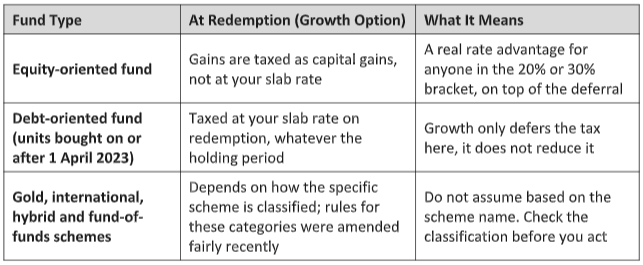
Do not assume a scheme is debt simply because it is not equity. Check how your specific scheme is classified before you act, because the scheme name will not tell you.
One more thing worth remembering: switching from IDCW to Growth is itself treated as a redemption, and it triggers tax on the gains already built up in the units you switch out of. It is worth running that calculation with your CA rather than acting on a rule of thumb.
And If You Tendered Shares in a Buyback
The rules flipped on 1 October 2024, and the old instinct is now expensive. Buyback proceeds used to be tax-free in your hands because the company paid the tax before distributing. Now the entire amount you receive is treated as a deemed dividend and taxed at your slab rate. For someone in the 30% bracket, that is a real bill on money they may well have assumed was clean.
There is a partial consolation most people miss. Because the sale consideration is treated as nil, your full cost of acquisition becomes a capital loss. Subject to the normal set-off rules, that loss can be adjusted against eligible capital gains and carried forward for up to eight years. Make sure your return picks up both halves, the dividend income and the loss.
If You Are an NRI, the Rules Are Different
Everything above describes resident investors. Non-residents sit under a separate regime and should not read the slab-rate rule as applying to them.
Dividends paid to a non-resident attract TDS at 20% plus applicable surcharge and cess, with no Rs 10,000 threshold. Many tax treaties bring that down, often to 10% or 15%, but the treaty rate is not automatic: you have to furnish a Tax Residency Certificate and Form 10F to claim it, and Form 121 is not available to non-residents at all. Since the treaty position varies by country of residence, this is worth a conversation with an adviser who handles cross-border cases.
Two Housekeeping Points
Advance tax applies once your liability after TDS crosses Rs 10,000 in a year, and dividend income counts towards it. This catches people who never paid advance tax because an employer handled it. There is a relief built in: since nobody can predict when a dividend will be declared, no interest is charged on an instalment shortfall caused by dividend income, provided you pay that tax in a later instalment. So when a large dividend lands, deal with it in the next instalment rather than leaving it to March.
On reconciliation, for the return you are filing now, the familiar documents still apply: Form 26AS for tax credits and the Annual Information Statement for the wider picture. From the current year onward, Form 26AS becomes Form 168, which merges both into one statement. You will meet it when you file next year, not this one.
What to Actually Do About All This
Track it as it arrives. Dividends below Rs 10,000 per company generate no TDS entry anywhere, which makes them the easiest to forget and the likeliest to cause trouble.
Reconcile before you file. Match your own record against the department's statements. Dividend mismatches are a common trigger for a notice.
Check how your funds are classified. Before assuming Growth saves you tax, confirm what the scheme actually is for tax purposes.
If you borrowed to invest, redo the maths. The interest shelter is gone from this year, so the numbers you ran when you set those positions up no longer hold.
The Bottom Line
For residents, dividends are taxed at your slab rate. TDS at 10% is only a part payment. The Rs 10,000 threshold works per company, not across your portfolio. Buyback money is now dividend income. Surcharge on dividends stops at 15%. And as of this year, the interest deduction is gone.
None of this is a reason to avoid dividend-paying stocks. It is a reason to stop treating dividend income as money somebody else has already dealt with.
Sources and References
[1] Income-tax Act, 2025, in force from 1 April 2026, replacing the Income-tax Act, 1961, as amended by the Finance Act, 2026.
[2] Finance Act, 2026, amendment to Section 93(2) of the Income-tax Act, 2025, withdrawing the interest deduction against dividend income and income from mutual fund units from tax year 2026-27. Section 93(1)(a) continues to allow a deduction for reasonable commission or remuneration paid for realising the dividend.
[3] TDS on dividends: Section 393 of the Income-tax Act, 2025 (earlier Sections 194 and 194K). Threshold raised from Rs 5,000 to Rs 10,000 per payer per year from 1 April 2025, Finance Act, 2025.
[4] Form 121, notified under Section 393(6) read with Rule 211 of the Income-tax Rules, 2026, replacing Forms 15G and 15H from 1 April 2026.
[5] Cap of 15% on surcharge on tax payable on dividend income and on capital gains under Sections 111A, 112 and 112A. Income Tax Department, tax rates.
[6] Taxation of debt-oriented mutual fund units acquired on or after 1 April 2023 at applicable slab rates irrespective of holding period, Finance Act, 2023. Definition of specified mutual fund amended by the Finance (No. 2) Act, 2024 with effect from FY 2025-26; see AMFI, Tax Regime for Mutual Funds.
[7] Taxation of buyback proceeds as deemed dividend with effect from 1 October 2024, Finance (No. 2) Act, 2024.
[8] TDS on dividends paid to non-residents and relief under applicable tax treaties, subject to furnishing of a Tax Residency Certificate and Form 10F.
[9] Form 168, notified under Rule 245 of the Income-tax Rules, 2026, replacing Form 26AS from tax year 2026-27; Form 26AS and AIS continue to apply for assessment year 2026-27.
Disclaimer:
Adroit Financial Services Private Limited (hereinafter referred to as "Adroit"), Registered Address: F-912, Titenium City Center, Nr. Sachin Towers, 100 Feet Ring Road, Anand Nagar, Manekbag, Ahmedabad, Ahmadabad City, Gujarat, India, 380015.
Correspondence Address: 401-402, Fourth Floor, Angel Mega Mall, Plot No. CK1, Kaushambi, Ghaziabad, Uttar Pradesh, India, 201010.
Registration Numbers: CIN: U74899GJ1994PTC128736 | SEBI Registration Numbers: NSE, BSE, MCX & NCDEX: INZ000173137 |Member Code: BSE-3034, NSE- 08538, MCX- 56790 & NCDEX- 01302 | DP- NSDL/CDSL- IN-DP-551-2021 | Research Analyst: INH100003084 | Portfolio Management Services (PMS): INP000005349 | Mutual Fund: ARN- 30091.
Standard Disclaimer: Investments in the securities market are subject to market risk, read all the related documents carefully before investing. This is for educational purposes and does not provide any advice/tips on Investment or recommend buying and selling of any stock. Adroit or its associates has not been debarred/ suspended by SEBI or any other regulatory authority for accessing/ dealing in securities Market. Adroit or its associates/analyst has not received any compensation/ managed or co-managed public offering of securities of the company covered by Analyst during the past twelve months. This document is solely for the personal information of the recipient, and must not be singularly used as the basis of any investment decision. Nothing in this document should be construed as investment or financial advice. Each recipient of this document should make such investigations as they deem necessary to arrive at an independent evaluation of an investment in the securities of the companies referred to in this document (including the merits and risks involved), and should consult their own advisors to determine the merits and risks of such an investment. The information in this document has been printed on the basis of publicly available information, internal data and other reliable sources believed to be true, but we do not represent that it is accurate or complete and it should not be relied on as such, as this document is for general guidance only. Neither Adroit, nor its directors, employees or affiliates shall be liable for any loss or damage that may arise from or in connection with the use of this information. Adroit Financial Services Private Limited has not independently verified all the information contained within this document. Accordingly, we cannot testify, nor make any representation or warranty, express or implied, to the accuracy, contents or data contained within this document.
Margin Trading Funding (MTF) is subject to provisions of SEBI circular
CIR/MRD/DP/54/2017 dated June 13,2017 and the terms and conditions mentioned in the rights and obligations statement issued by Adroit Financial Services Private Limited.
Read More On: www.adroitfinancial.com