
Mutual Funds vs Direct Stocks: How to Decide What's Right for Your Portfolio
- Details
Mutual Funds vs Direct Stocks: How to Decide What's Right for Your Portfolio
On 11 March 2025, IndusInd Bank's shares fell 27.17% in a single day, the biggest fall in their history, after the bank disclosed problems in its derivatives accounts. About Rs. 18,000 crore of market value disappeared.
Two investors owned the bank that morning. One held it directly, the other through a mutual fund. Same company, same news, very different mornings, and neither of them is the hero of this story.
A Tale of Two Screens
Kabir had about Rs. 8 lakh across six stocks, and IndusInd was roughly a sixth of it. By the close he had lost around Rs. 35,000, close to 4.5% of everything he owned, in one day.
Ananya owned the same bank through a flexi cap fund, where it was one of fifty-odd holdings at a small weight. Her fund's value moved by a fraction of a percent. She heard about it from a news alert.
But her comfort had a price. Ananya never chose to own that bank, could not sell it that morning, and kept owning it until the fund manager decided otherwise. Kabir owned a decision. Ananya owned an outcome.
And the day did not prove funds are smarter. That quarter, mutual funds cut their stake in the bank by about 2.76 percentage points. Foreign investors raised theirs by nearly five points to 29.5%, and retail shareholders went from 16.2% to 17.9%. Professionals sold, professionals bought, and ordinary investors bought too.
It got messier. The stock fell 38% between 6 and 12 March, then rose 13% in three sessions once an external review by PwC put the loss at Rs. 1,979 crore. Anyone who panicked and sold at the bottom did worse than someone who simply held on. Everyone was guessing. What differed was how much of one guess each person owned.
What Each One Gives You
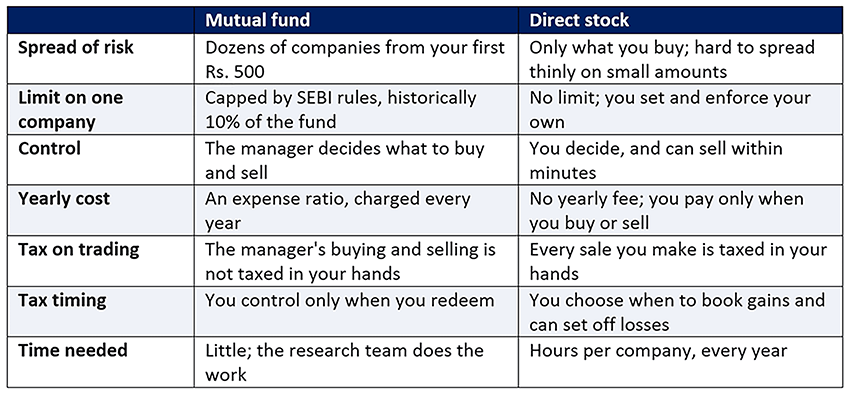
Two rows deserve a closer look.
The limit on one company is why Ananya barely felt the IndusInd fall. SEBI rules have long capped how much of a fund can sit in a single company at 10%. Under the new rules from 1 April 2026, SEBI sets this limit directly rather than fixing it in the regulations, but the idea is unchanged. Kabir had no such rule, so one company quietly grew to a sixth of his money.
Tax on trading is the hidden advantage of funds. Tax rates are the same for both: 12.5% on long-term gains above Rs. 1.25 lakh a year and 20% on short-term gains, with a 12-month holding period. But when a fund manager sells half the portfolio and buys something else, you pay nothing, because your units have not moved. If you rebalance your own stocks, every profitable sale is taxed. On the other hand, a stock investor can choose to book losses to cut the tax on gains, which a fund investor cannot do.
Where Each One Can Let You Down
Funds: the S&P SPIVA India report for 2025 found that 75% of active large cap funds did worse than their benchmark index in one year, and 76.3% over ten years. Mid and small cap funds had their best year against the index since 2014, yet over the decade most funds in every category fell behind. Holding five similar funds can also mean owning the same large companies five times.
Stocks: a century-long study of about 30,000 US companies found that fewer than half gave a positive return over their lifetime, and just 46 companies created half of all the wealth. In India, Motilal Oswal's wealth creation study found the top 100 companies added Rs. 148 trillion in value between 2020 and 2025. The big winners are real, but rare, and a fund cannot let any one of them grow very large in your portfolio. A direct investor can. Positions also drift: Kabir never decided that one bank should be a sixth of his savings. The stock went up, he kept adding, and the weight decided itself.
The Cost Nobody Compares
A fund's yearly fee looks tiny, but it is charged every year on your whole balance. Half a percent a year barely shows on a statement, yet over twenty years it adds up to a meaningful slice of your returns. That is why direct plans, which leave out distributor commission, cost less than regular plans. From 1 April 2026, SEBI also cut the maximum fee for index funds and ETFs from 1% to 0.90%.
Stocks have no yearly fee, but they are not free. You pay in time instead: an annual report, four quarterly results and four earnings calls, for every company, every year. Those hours are worth it if you enjoy the work, and costly if you do not.
Most Indians Already Do Both
By August 2026, India had 23.77 crore demat accounts and over 10 crore active SIP accounts. Monthly SIP money hit a record Rs. 32,297 crore, equity funds saw inflows for the 66th month in a row, and mutual fund assets reached Rs. 87.08 lakh crore. Most families run a SIP and own a few stocks as well.
There is also a third route that often gets forgotten: index funds and ETFs. They spread your money across the market without a manager picking stocks, usually at a lower cost. So the real choice is not funds against stocks. It is direct stock picking, active funds, or the market itself, in whatever mix suits you.
A Simple Way to Combine Them
Many investors use a core and satellite approach. The core is the bigger part of the money, kept in diversified funds or index funds, so that no single company can do serious damage. The satellite is a smaller part, in a few stocks you genuinely understand and follow. Decide the split, and the most any one stock can be, before the market tests you, not on a bad day like 11 March.
Five Questions That Decide It
• How much are you investing? Small monthly amounts are easier to spread through a fund. As your savings grow, owning stocks directly becomes more practical.
• Do you enjoy the work? Read one annual report and one earnings call first. If it feels like homework, a fund suits you better.
• How big can one stock get? Set a maximum weight before you buy, not during a fall.
• How long will you hold? Someone who holds for decades saves on yearly fees with stocks. Someone who changes their holdings often usually saves on tax inside a fund.
• Why do you want to pick? A view on a business is a reason. A slow SIP is not.
The Bottom Line
Kabir and Ananya owned the same bank on the same morning. He owned a decision, with its pain and its upside. She owned an outcome, with its spread of risk and its lack of control. Neither made a mistake. The mistake is not knowing which one you have chosen.
A fund buys you rules, spread and someone else's judgement. A stock buys you control and freedom to size your bets. The real decision is how much of your money sits in each, and whether you chose that mix or let it drift.
Sources and References
[1] SEBI (Issue of Capital and Disclosure Requirements) (Amendment) Regulations, 2026, Notification No. SEBI/LAD-NRO/GN/2026/299 dated 16 March 2026: draft abridged prospectus at the DRHP stage, standardised Part E format, removal of the Summary of the Offer Document, QR code and link on application forms, and non-transferability of pledged pre-issue shares during lock-in.
[2] SEBI (ICDR) amendment notified 31 October 2025, effective 30 November 2025: anchor reservation raised to 40%, comprising 33% for mutual funds and 7% for life insurers and pension funds.
[3] Securities Contracts (Regulation) Amendment Rules, 2026, G.S.R. 184(E), notified 13 March 2026, substituting Rule 19(2)(b) of the Securities Contracts (Regulation) Rules, 1957: graded minimum public offer, including Rs. 15,000 crore and 1% above Rs. 5 lakh crore with a 2.5% floor, and extended minimum public shareholding timelines.
[4] SEBI (ICDR) (Amendment) Regulations, 2025, No. SEBI/LAD-NRO/GN/2025/233, notified March 2025: SME eligibility, offer for sale limits and minimum application of two lots above Rs. 2 lakh. SEBI press release on the board meeting of 19 June 2026 approving a review of the SME fundraising framework.
[5] SEBI (ICDR) (Third Amendment) Regulations, August 2021: promoter lock-in of 18 months, three years where the majority of fresh issue proceeds are for capital expenditure, and six months for most other pre-issue shareholders. SEBI board decisions of December 2021 and ICDR amendments of January 2022: anchor lock-in of 30 and 90 days, and caps of 25% on general corporate purposes and 35% including unidentified acquisitions.
Disclaimer:
Adroit Financial Services Private Limited (hereinafter referred to as "Adroit"), Registered Address: F-912, Titenium City Center, Nr. Sachin Towers, 100 Feet Ring Road, Anand Nagar, Manekbag, Ahmedabad, Ahmadabad City, Gujarat, India, 380015.
Correspondence Address: 401-402, Fourth Floor, Angel Mega Mall, Plot No. CK1, Kaushambi, Ghaziabad, Uttar Pradesh, India, 201010.
Registration Numbers: CIN: U74899GJ1994PTC128736 | SEBI Registration Numbers: NSE, BSE, MCX & NCDEX: INZ000173137 |Member Code: BSE-3034, NSE- 08538, MCX- 56790 & NCDEX- 01302 | DP- NSDL/CDSL- IN-DP-551-2021 | Research Analyst: INH100003084 | Portfolio Management Services (PMS): INP000005349 | Mutual Fund: ARN- 30091.
Standard Disclaimer: Investments in the securities market are subject to market risk, read all the related documents carefully before investing. This is for educational purposes and does not provide any advice/tips on Investment or recommend buying and selling of any stock. Adroit or its associates has not been debarred/ suspended by SEBI or any other regulatory authority for accessing/ dealing in securities Market. Adroit or its associates/analyst has not received any compensation/ managed or co-managed public offering of securities of the company covered by Analyst during the past twelve months. This document is solely for the personal information of the recipient, and must not be singularly used as the basis of any investment decision. Nothing in this document should be construed as investment or financial advice. Each recipient of this document should make such investigations as they deem necessary to arrive at an independent evaluation of an investment in the securities of the companies referred to in this document (including the merits and risks involved), and should consult their own advisors to determine the merits and risks of such an investment. The information in this document has been printed on the basis of publicly available information, internal data and other reliable sources believed to be true, but we do not represent that it is accurate or complete and it should not be relied on as such, as this document is for general guidance only. Neither Adroit, nor its directors, employees or affiliates shall be liable for any loss or damage that may arise from or in connection with the use of this information. Adroit Financial Services Private Limited has not independently verified all the information contained within this document. Accordingly, we cannot testify, nor make any representation or warranty, express or implied, to the accuracy, contents or data contained within this document.
Margin Trading Funding (MTF) is subject to provisions of SEBI circular
CIR/MRD/DP/54/2017 dated June 13,2017 and the terms and conditions mentioned in the rights and obligations statement issued by Adroit Financial Services Private Limited.
Read More On: www.adroitfinancial.com