
India-US Trade Deal 2026: Which Indian Sectors Could Benefit the Most?
- Details
Why This Trade Deal Matters
The recent India–US trade announcement has created strong optimism across businesses, investors, and policymakers. Many headlines suggest it could open new opportunities for Indian exports and strengthen economic ties between the two countries.
However, it is important to understand one key point:
This is not a final trade agreement yet.
What has been announced is only a framework for future negotiations, the first step toward a broader bilateral trade deal.
Even so, the framework provides useful signals about:
- Which Indian sectors may benefit
- What risks remain
- How this could influence the stock market and long-term growth
Let’s break this down in clear and simple terms.
What Has Changed So Far?
The biggest immediate relief comes from US tariff reductions on Indian exports.
Earlier, several Indian products were facing tariffs as high as 50%. Now, many of these have been reduced to around 18%, and in a few key sectors, even 0%. This improves India’s price competitiveness in the US market, especially compared with other Asian exporters.
But there is another side to the story.
India has also made clear commitments, including:
- Reducing tariffs on many US industrial and agricultural goods
- Expanding imports from the United States
- Planning purchases of nearly $500 billion worth of US products over five years
So the real question becomes:
Will India’s long-term gains justify these large commitments?
Key Indian Sectors That Could Benefit
1. Pharmaceuticals
India already plays a major role in supplying generic medicines to the United States.
With zero-duty access for essential drugs, Indian pharma exporters may see:
- Improved profit margins
- Faster regulatory movement
- Stable long-term demand
This makes pharmaceuticals one of the strongest structural beneficiaries.
2. Gems and Jewellery
Tariffs on processed diamonds and value-added jewellery are expected to fall to 0%.
Because India is a global hub for diamond processing, this could:
- Boost exports to the US luxury market
- Improve margins for jewellery companies
- Support employment in Surat and Mumbai
This sector stands out as a clear positive winner.
3. Textiles, Apparel, Leather and Footwear
These labour-intensive industries were heavily impacted by earlier 50% tariffs.
With tariffs now around 18%, Indian products regain competitiveness.
Possible outcomes include:
- Recovery in export orders
- Stronger MSME activity
- Job creation across manufacturing clusters
This benefit is economically and socially significant.
4. Engineering, Machinery and Auto Components
The United States is seeking alternatives to China-centric supply chains.
India’s engineering and component manufacturers could gradually gain:
- Better market access
- Opportunities in EV and industrial supply chains
- Long-term export growth
This is more of a slow structural opportunity than a quick boost.
5. Technology, Data Infrastructure and Semiconductors
India plans to import large volumes of:
- Energy
- Advanced chips and GPUs
- Data-center infrastructure
In return, India may gain:
- Faster digital and AI ecosystem growth
- Stronger technology collaboration
- Long-term innovation capacity
But this sector will likely deliver results over years, not months.
6. Agriculture (Selective Gains with Protection)
Certain exports like spices, tea, coffee, fruits, and processed foods may receive zero additional duty.
At the same time, sensitive domestic sectors such as dairy remain protected, helping:
- Farmers’ income stability
- Rural employment
- Food security
Tariff Changes Across Major Export Sectors
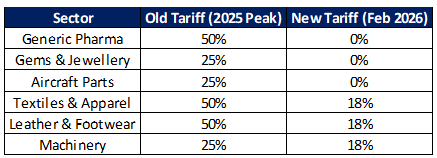
This comparison clearly shows where the strongest export advantages are emerging.
Key Risks Investors Should Watch
Despite the positive signals, several important uncertainties remain:
1. The deal is not final.
Negotiations are still ongoing, and final terms could change.
2. India’s import commitment is very large
Purchasing $500 billion of US goods could pressure:
- The trade balance
- The Indian rupee
- Domestic competitiveness
3. US concessions may be conditional
Some tariff relief depends on:
- National security reviews
- Policy decisions
- Geopolitical alignment
Benefits may therefore be reversible.
4. Value Mismatch Risk
India could Continue exporting low-value goods while importing high-value technology, limiting net gains
What This Means for the Stock Market
Short-Term Impact
- Announcement-driven rallies in select sectors
- Increased foreign investor attention
- Higher volatility as details evolve
Medium- to Long-Term Impact
- Better earnings visibility for export-linked sectors
- Gradual shift toward manufacturing and industrial growth
- Structural change rather than sudden market boom
In simple terms:
This is a long-term opportunity, not a quick market trigger.
The Bottom Line
The India–US Trade Deal 2026 is not a completed agreement, but it is an important strategic starting point.
Clear potential winners:
- Pharmaceuticals
- Gems and jewellery
- Textiles and labour-intensive exports
- Engineering and manufacturing over time
Key concerns:
- Large US import commitments
- Policy uncertainty
- Currency and trade balance risks
For investors, the most practical takeaway is:
Focus less on headlines and more on companies that can truly execute and scale.
Because in financial markets, long-term performance is driven by execution, not announcements.
Sources
· The White House. United States–India Joint Statement on Bilateral Trade Framework, February 2026.
· Ministry of External Affairs, Government of India. Official statements and policy communications on India–US trade discussions.
· Public-domain economic data and widely reported international trade analysis from credible financial news agencies and policy sources.
Disclaimer:
Adroit Financial Services Private Limited (hereinafter referred to as “Adroit”), Registered Address: F-912, Titenium City Center, Nr. Sachin Towers, 100 Feet Ring Road, Anand Nagar, Manekbag, Ahmedabad, Ahmadabad City, Gujarat, India, 380015. Correspondence Address: 401-402, Fourth Floor,Angel Mega Mall, Plot No. CK1, Kaushambi, Ghaziabad, Uttar Pradesh, India, 201010.Registration Nos.: CIN: U74899GJ1994PTC128736|SEBI Registration Nos.: NSE, BSE, MCX & NCDEX : INZ000173137|Member code: BSE-3034, NSE- 08538, MCX- 56790 & NCDEX- 01302|DP- NSDL/CDSL – IN-DP-551-2021|Research Analyst: INH100003084| Portfolio Management Services (PMS): INP000005349. Standard Disclaimer: Investments in the securities market are subject to market risk, read all the related documents carefully before investing. This is for educational purposes and does not provide any advice/tips on Investment or recommend buying and selling of any stock. Adroit or its associates has not been debarred/ suspended by SEBI or any other regulatory authority for accessing/ dealing in securities Market. Adroit or its associates/analyst has not received any compensation/ managed or co-managed public offering of securities of the company covered by Analyst during the past twelve months. This document is solely for the personal information of the recipient, and must not be singularly used as the basis of any investment decision. Nothing in this document should be construed as investment or financial advice. Each recipient of this document should make such investigations as they deem necessary to arrive at an independent evaluation of an investment in the securities of the companies referred to in this document (including the merits and risks involved), and should consult their own advisors to determine the merits and risks of such an investment. The information in this document has been printed on the basis of publicly available information, internal data and other reliable sources believed to be true, but we do not represent that it is accurate or complete and it should not be relied on as such, as this document is for general guidance only. Neither Adroit, nor its directors, employees or affiliates shall be liable for any loss or damage that may arise from or in connection with the use of this information. Adroit Financial Services Private Limited has not independently verified all the information contained within this document. Accordingly, we cannot testify, nor make any representation or warranty, express or implied, to the accuracy, contents or data contained within this document. Margin Trading Funding (MTF) is subject to provisions of SEBI circular CIR/MRD/DP/54/2017 dated June 13,2017 and the terms and conditions mentioned in the rights and obligations statement issued by Adroit Financial Services Pvt. Ltd.
Read more on: www.adroitfinancial.com