
Why the Rupee Falls When the Dollar Rises — A Simple Investor Guide
- Details
Introduction: Why This Matters
Currency movements influence inflation, stock markets, corporate earnings, and overall economic stability. For Indian investors, the exchange rate between the Indian Rupee (INR) and the US Dollar (USD) is particularly important because India relies heavily on global trade, foreign investment, and imported commodities such as crude oil.
A commonly observed pattern is that when the US Dollar strengthens globally, the Indian Rupee tends to weaken. This inverse relationship exists because global capital flows, trade payments, and investor preferences shift toward the dollar when it offers better returns or greater stability. Understanding this dynamic helps investors interpret market trends and economic developments more accurately.
USD/INR Exchange Rate Trend (2015–2026)
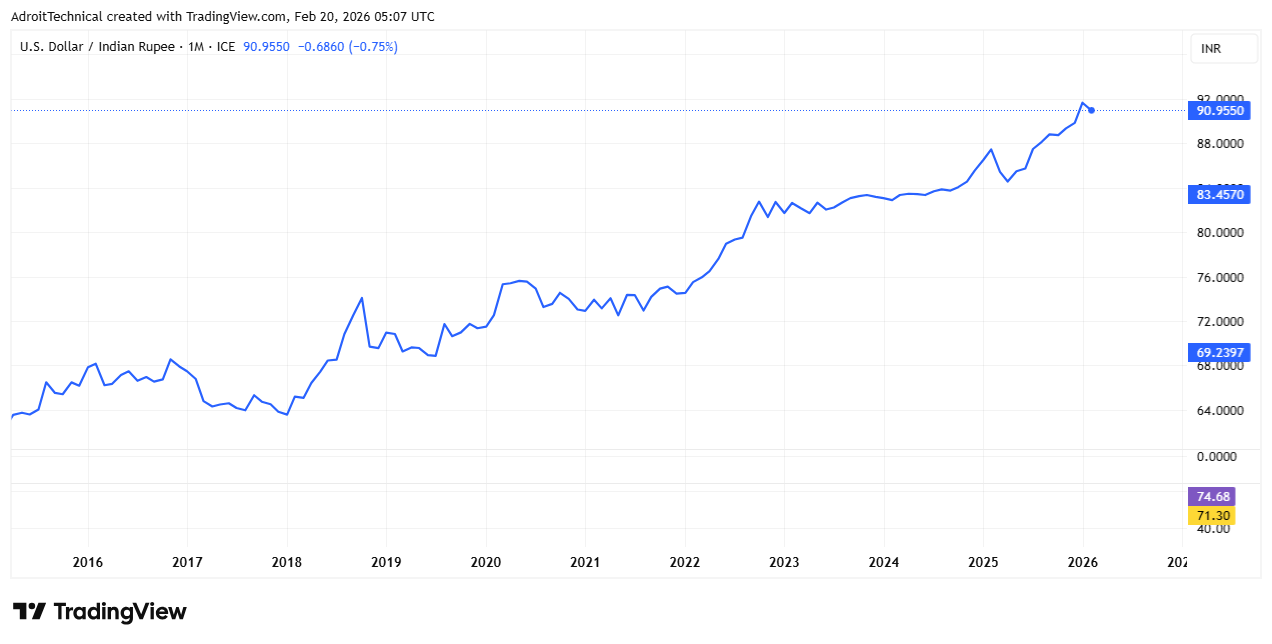
Source: TradingView
How Exchange Rates Work
Exchange rates are determined by the demand and supply of currencies in international markets. When demand for the US Dollar increases relative to the Rupee, the dollar appreciates and the rupee depreciates.
Demand and supply dynamics:
Foreign investors must buy rupees to invest in India, which strengthens the rupee. Conversely, Indian importers must buy dollars to pay for foreign goods, increasing dollar demand and weakening the rupee.
Interest rate differences:
Higher interest rates in the United States attract global investors seeking better returns. This increases demand for dollar-denominated assets, strengthening the dollar relative to emerging market currencies.
Trade deficit and oil imports:
India imports a large portion of its crude oil, which is priced in dollars. When oil prices rise, India’s demand for dollars increases, putting downward pressure on the rupee.
Global Risk Sentiment:
During periods of uncertainty, investors prefer holding dollars because of their liquidity and stability. This safe-haven demand strengthens the dollar and weakens risk-sensitive currencies like the rupee
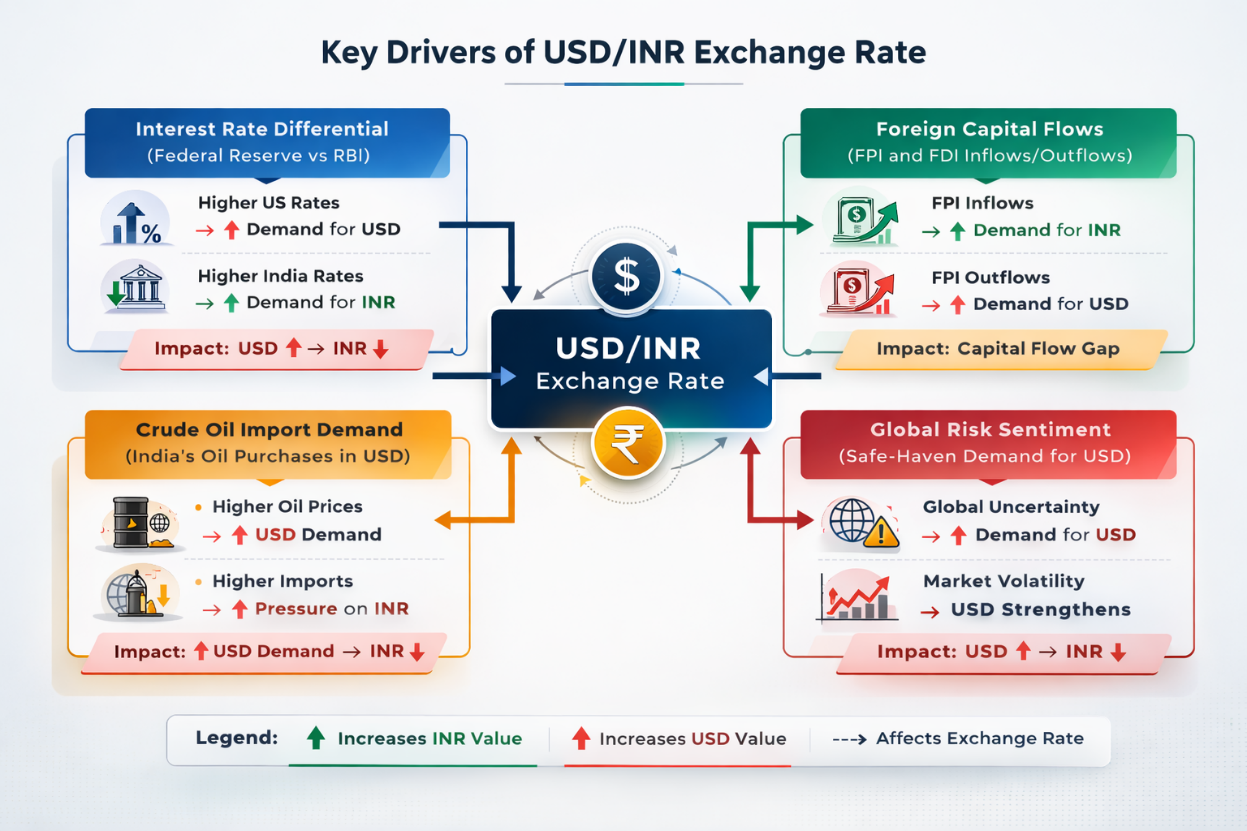
Source: Authors' illustration (AI-generated for educational purposes)
Main Reasons the Rupee Falls When the Dollar Rises
US Federal Reserve Policy and Capital Flows
When the US Federal Reserve raises interest rates, US financial assets become more attractive to global investors. Capital flows toward the United States increase, raising demand for dollars and reducing demand for emerging market currencies, including the rupee.
Foreign Investor Flows
Foreign Portfolio Investors (FPIs) play a significant role in Indian financial markets. When global conditions favor the US, these investors may withdraw funds from Indian equities and bonds. This increases dollar demand and weakens the rupee.
India’s Oil Import Dependence
India imports most of its crude oil requirements. Higher oil prices increase the need for dollars to pay import bills, creating structural demand for the dollar and pressure on the rupee.
Inflation and Global Uncertainty
Higher inflation reduces a currency’s purchasing power. Additionally, global uncertainty increases demand for safe assets like the US Dollar, strengthening it relative to emerging market currencies.
Impact On Indian Investors and Markets
Currency movements affect different parts of the economy and markets in distinct ways.
Inflation and fuel prices:
A weaker rupee increases the cost of imports, especially fuel, which contributes to higher inflation.
Export-oriented sectors:
Companies earning revenue in dollars, such as IT services and pharmaceuticals, benefit because their earnings translate into higher rupee income.
Import-dependent sectors:
Businesses reliant on imports face higher costs, which can affect profitability.
Stock Market Volatility:
Currency weakness is often associated with foreign investment outflows, which can increase market volatility.
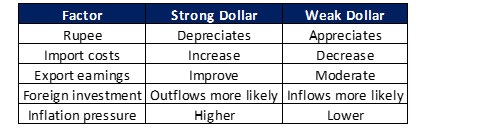
Strong Dollar vs Weak Dollar: Impact on India
What Investors Should Watch
Key indicators that influence currency trends include:
- Interest rate decisions by the US Federal Reserve and Reserve Bank of India
- Global crude oil prices
- Foreign investment inflows and outflows
- Inflation trends in India and globally
Monitoring these factors helps investors understand broader market conditions.
Conclusion
The rupee typically weakens when the dollar strengthens due to global capital flows, interest rate differences, oil import dependence, and investor risk preferences. These movements reflect structural economic relationships rather than isolated domestic factors.
For investors, exchange rates provide important signals about inflation, corporate earnings, and market stability. Understanding currency dynamics improves the ability to interpret macroeconomic trends and financial market behavior more effectively.
Sources & References
- Reserve Bank of India (RBI) – Monetary Policy Reports and Exchange Rate Data
- International Monetary Fund (IMF) – World Economic Outlook Database
- World Bank – Global Economic Indicators
- Ministry of Commerce and Industry, Government of India – Trade Statistics
- US Federal Reserve – Monetary Policy Statements
- Bank for International Settlements (BIS) – Global Currency and Liquidity Report
Disclaimer:
Adroit Financial Services Private Limited (hereinafter referred to as “Adroit”), Registered Address: F-912, Titenium City Center, Nr. Sachin Towers, 100 Feet Ring Road, Anand Nagar, Manekbag, Ahmedabad, Ahmadabad City, Gujarat, India, 380015. Correspondence Address: 401-402, Fourth Floor,Angel Mega Mall, Plot No. CK1, Kaushambi, Ghaziabad, Uttar Pradesh, India, 201010.Registration Nos.: CIN: U74899GJ1994PTC128736|SEBI Registration Nos.: NSE, BSE, MCX & NCDEX : INZ000173137|Member code: BSE-3034, NSE- 08538, MCX- 56790 & NCDEX- 01302|DP- NSDL/CDSL – IN-DP-551-2021|Research Analyst: INH100003084| Portfolio Management Services (PMS): INP000005349. Standard Disclaimer: Investments in the securities market are subject to market risk, read all the related documents carefully before investing. This is for educational purposes and does not provide any advice/tips on Investment or recommend buying and selling of any stock. Adroit or its associates has not been debarred/ suspended by SEBI or any other regulatory authority for accessing/ dealing in securities Market. Adroit or its associates/analyst has not received any compensation/ managed or co-managed public offering of securities of the company covered by Analyst during the past twelve months. This document is solely for the personal information of the recipient, and must not be singularly used as the basis of any investment decision. Nothing in this document should be construed as investment or financial advice. Each recipient of this document should make such investigations as they deem necessary to arrive at an independent evaluation of an investment in the securities of the companies referred to in this document (including the merits and risks involved), and should consult their own advisors to determine the merits and risks of such an investment. The information in this document has been printed on the basis of publicly available information, internal data and other reliable sources believed to be true, but we do not represent that it is accurate or complete and it should not be relied on as such, as this document is for general guidance only. Neither Adroit, nor its directors, employees or affiliates shall be liable for any loss or damage that may arise from or in connection with the use of this information. Adroit Financial Services Private Limited has not independently verified all the information contained within this document. Accordingly, we cannot testify, nor make any representation or warranty, express or implied, to the accuracy, contents or data contained within this document. Margin Trading Funding (MTF) is subject to provisions of SEBI circular CIR/MRD/DP/54/2017 dated June 13,2017 and the terms and conditions mentioned in the rights and obligations statement issued by Adroit Financial Services Pvt. Ltd.
Read More On: www.adroitfinancial.com