
How to Start Investing in the Stock Market in 2026: Step-by-Step Guide
- Details
Introduction: Investing in a Structurally Changing Market
Retail participation in Indian equity markets has expanded significantly over the past five years. The number of demat accounts has risen sharply, systematic investment plan (SIP) inflows remain structurally strong, and digital brokerage penetration continues to deepen. Access to markets is no longer the constraint. Preparation is.
In 2026, investing requires more than opening an account. It requires financial stability, clarity of strategy, and an understanding of risk. Markets are increasingly integrated with global capital flows, macroeconomic cycles, and policy shifts. A structured approach is therefore essential.
Step 1: Establish Financial Readiness
Before allocating capital to equities, investors should ensure financial resilience.
- Emergency liquidity: Maintain 3–6 months of expenses in low-risk, liquid instruments.
- Insurance protection: Health and term coverage safeguard long-term plans.
- Debt discipline: High-interest liabilities reduce investment efficiency and should be addressed first.
- Risk alignment: Risk capacity (financial ability to absorb losses) must align with risk tolerance (psychological comfort with volatility).
Equity investing should enhance financial stability, not substitute for it.
Step 2: Understand Your Investment Vehicles
Equity exposure can be obtained through multiple structures. Each carries distinct characteristics.
| Investment Type | Risk Level | Suitable For | Example |
| Direct Stocks | High | Investors comfortable analyzing companies | Listed equities |
| Mutual Funds | Moderate | Investors seeking professional management | Actively Managed equity funds |
| Index Funds | Moderate to Low | long-term passive investors | Nifty 50 Index Fund |
| ETFs | Moderate | Investors seeking low-cost tradable exposure | Nifty ETF |
| SIP (via funds) | Varies by asset | Investors preferring disciplined investing | Monthly equity SIP |
Direct equity investing requires balance sheet analysis, earnings tracking, and sector awareness. Passive structures such as index funds reduce concentration risk and management bias. SIPs promote consistency and reduce timing risk.
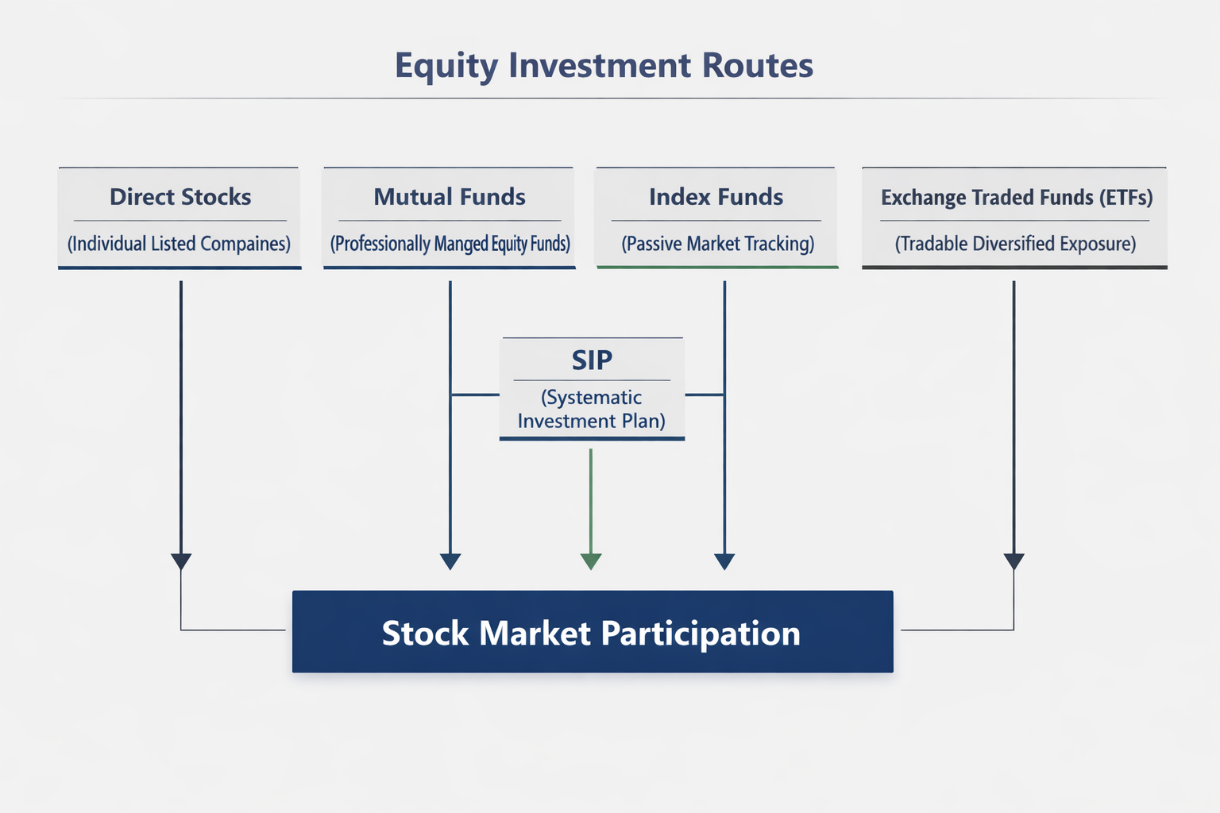
Source: Author's illustration (AI-generated for educational purposes)
Step 3: Open a Regulated Demat and Trading Account
Participation in Indian capital markets requires:
- Demat account: Electronic holding of securities
- Trading account: Access to exchange transactions
These operate under the regulatory framework of the Securities and Exchange Board of India (SEBI), ensuring compliance and investor protection.
When selecting a broker, investors should assess:
- Regulatory standing and transparency
- Brokerage structure and cost efficiency
- Platform stability and execution quality
- Research access and reporting tools
Digital onboarding has simplified access. Investors may complete secure e-KYC registration through regulated platforms such as:
https://ekyc.adroitfinancial.com/adroitfinancial/individual
The process typically includes PAN authentication, bank verification, identity documentation, and video-based KYC validation.
Ease of access, however, should not override due diligence. Platform credibility remains fundamental.
Step 4: Define Your Investment Framework
Clarity reduces behavioral errors.
- Long-term investing vs trading: Long-term investing focuses on earnings growth and compounding. Trading targets short-term price volatility.
- Active vs passive strategy: Active approaches attempt to outperform benchmarks; passive strategies replicate market indices at lower cost.
- Asset allocation: Portfolio distribution across equities, fixed income, and cash should reflect time horizon and objectives.
- Diversification: Sector and stock concentration increase volatility exposure.
Structured frameworks mitigate reactionary decision-making during market corrections.
Step 5: Implement Gradually and Review Periodically
Beginning with calibrated allocations allows investors to build experience without excessive risk exposure. Equity markets are cyclical; volatility is structural, not exceptional.
Disciplined investors:
- Invest systematically rather than attempt market timing
- Review portfolio allocation periodically
- Rebalance when allocations materially deviate
- Avoid leverage and derivatives without adequate understanding
Compounding rewards consistency, not impulsiveness.
Common Mistakes to Avoid
- Investing without fundamental understanding
- Overconcentration in trending sectors
- Acting on unverified market tips
- Excessive trading driven by short-term noise
- Ignoring risk-adjusted return considerations
Markets reward discipline over activity.
Conclusion
In 2026, the barriers to investing are technological, not structural. Access is abundant; discipline remains scarce.
Successful investing is not determined by entry timing but by preparation, allocation clarity, and behavioral control. Investors who combine financial readiness with structured strategy are better positioned to navigate economic cycles and market volatility.
In financial markets, access creates opportunity, but discipline creates outcomes.
Sources & References
- Securities and Exchange Board of India (SEBI) – Investor Education and Market Reports
- Reserve Bank of India (RBI) – Financial Stability Reports
- National Stock Exchange (NSE) – Market Participation Data
- Bombay Stock Exchange (BSE) – Investor Awareness Publications
- Government of India – Financial Inclusion and Market Development Data
Disclaimer:
Adroit Financial Services Private Limited (hereinafter referred to as “Adroit”), Registered Address: F-912, Titenium City Center, Nr. Sachin Towers, 100 Feet Ring Road, Anand Nagar, Manekbag, Ahmedabad, Ahmadabad City, Gujarat, India, 380015. Correspondence Address: 401-402, Fourth Floor,Angel Mega Mall, Plot No. CK1, Kaushambi, Ghaziabad, Uttar Pradesh, India, 201010.Registration Nos.: CIN: U74899GJ1994PTC128736|SEBI Registration Nos.: NSE, BSE, MCX & NCDEX : INZ000173137|Member code: BSE-3034, NSE- 08538, MCX- 56790 & NCDEX- 01302|DP- NSDL/CDSL – IN-DP-551-2021|Research Analyst: INH100003084| Portfolio Management Services (PMS): INP000005349. Standard Disclaimer: Investments in the securities market are subject to market risk, read all the related documents carefully before investing. This is for educational purposes and does not provide any advice/tips on Investment or recommend buying and selling of any stock. Adroit or its associates has not been debarred/ suspended by SEBI or any other regulatory authority for accessing/ dealing in securities Market. Adroit or its associates/analyst has not received any compensation/ managed or co-managed public offering of securities of the company covered by Analyst during the past twelve months. This document is solely for the personal information of the recipient, and must not be singularly used as the basis of any investment decision. Nothing in this document should be construed as investment or financial advice. Each recipient of this document should make such investigations as they deem necessary to arrive at an independent evaluation of an investment in the securities of the companies referred to in this document (including the merits and risks involved), and should consult their own advisors to determine the merits and risks of such an investment. The information in this document has been printed on the basis of publicly available information, internal data and other reliable sources believed to be true, but we do not represent that it is accurate or complete and it should not be relied on as such, as this document is for general guidance only. Neither Adroit, nor its directors, employees or affiliates shall be liable for any loss or damage that may arise from or in connection with the use of this information. Adroit Financial Services Private Limited has not independently verified all the information contained within this document. Accordingly, we cannot testify, nor make any representation or warranty, express or implied, to the accuracy, contents or data contained within this document. Margin Trading Funding (MTF) is subject to provisions of SEBI circular CIR/MRD/DP/54/2017 dated June 13,2017 and the terms and conditions mentioned in the rights and obligations statement issued by Adroit Financial Services Pvt. Ltd.
Read more on: www.adroitfinancial.com