
Revenue vs. Profit – What’s the Difference and Why It Matters for Investors
- Details
Why This Topic Matters (Especially for Investors)
If you've ever watched business news or browsed through a company’s financial report, you’ve probably heard the words “revenue” and “profit.”
But here's the thing: high revenue doesn’t always mean high profit. And as an investor, confusing the two can lead to bad stock decisions.
Many beginner investors are drawn to flashy sales numbers. But experienced investors dig deeper to understand whether that revenue is sustainable, and whether the profit is real or masked by accounting tricks or one-time gains.
In this blog, we’ll not only explain the difference between revenue and profit, but also how these numbers can mislead you if you don’t know what to watch out for.
What is Revenue?
Revenue (also called sales or top line) is the total money a business earns from its operations, like selling products or services, before subtracting any costs.
Example (Tea Stall Analogy):
Suppose you own a tea stall and sell 1,000 cups of tea at ₹10 each.
Revenue = 1,000 x ₹10 = ₹10,000
This is your total income, regardless of what you spent on milk, sugar, gas, or rent.
Important Investor Insight:
While high revenue can indicate market demand, it doesn't tell you if the business is making money. You need to look further.
What is Profit?
Profit (also called net income or bottom line) is what’s left after subtracting all costs and expenses, like raw materials, salaries, rent, taxes, and loan interest.
Continuing the Tea Stall Example:
- Revenue = ₹10,000
- Expenses = ₹7,000 (milk, sugar, gas, rent)
- Profit = ₹10,000 – ₹7,000 = ₹3,000
Now that ₹3,000 is your actual earning.
But what if gas prices suddenly rise and expenses go to ₹11,000?
Now you have a loss of ₹1,000, despite having high revenue.
Types of Profit: More Than Just “Net”
1. Gross Profit = Revenue – Cost of Goods Sold (COGS)
Tells you how efficient the company is in producing or sourcing its product.
2. Operating Profit (EBIT) = Gross Profit – Operating Expenses
Shows profit from core business before interest and taxes.
3. Net Profit = Operating Profit – All Other Expenses (interest, taxes, one-time costs)
The most complete view of profit, but also the most prone to manipulation.
Red Flags Investors Must Watch
Understanding revenue and profit is not enough. You must analyze what’s behind those numbers:
Red Flags in Revenue
- Revenue Growth without Profit Growth: This may signal rising costs or unsustainable pricing.
- Sudden Revenue Spikes: Check if it's from core operations or one-time sales (e.g., asset sales).
Red Flags in Profit
- One-Time Gains: Companies may sell land or investments to boost net profit temporarily.
Always check the "Other Income" - Accounting Adjustments: Non-cash items like deferred taxes or goodwill write-offs can distort real earnings.
- Understated Expenses: Low R&D or advertising might increase short-term profit but hurt long-term sustainability.
Key Ratios Every Investor Should Use
Here are some ratios that help you understand the relationship between revenue, profit, and business quality:
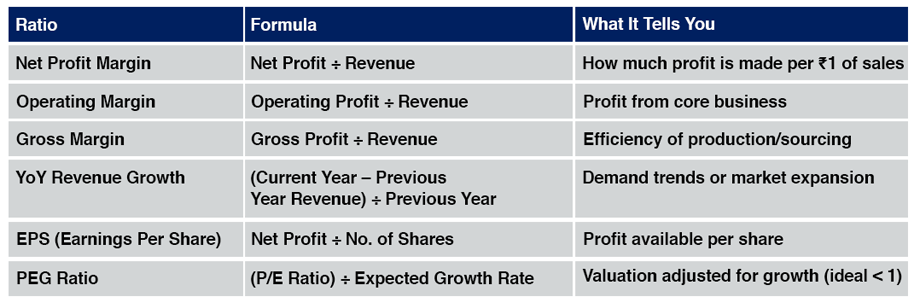
Pro Tip: Compare margins and ratios year-over-year and against competitors in the same industry.
Real-Life Example: How Revenue-Profit Gap Misleads
Let’s say Company A has ₹5,000 crore in revenue and ₹500 crore in profit.
Company B has ₹3,000 crore in revenue and ₹600 crore profit.
If you just look at revenue, Company A looks better.
But Company B has a higher profit margin (20%) compared to A's 10%.
So if you’re investing for profitability and returns, Company B is stronger.
Final Thoughts – Revenue Shows Sales, Profit Shows Strength
To wrap it up:
- Revenue tells you how much money comes in.
- Profit tells you how much money stays after costs.
- Don’t be impressed by revenue alone.
- Always check margins, one-time items, and growth sustainability.
Investor Tip: Before you invest in any stock, always go through:
- Profit & Loss Statement
- Segment-wise performance
- Notes to accounts (for one-time adjustments)
- Management commentary on earnings calls
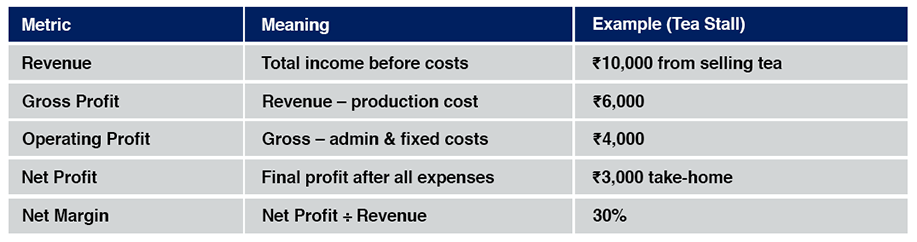
Recap Table
Conclusion
Understanding the difference between revenue and profit isn’t just basic finance, it’s a powerful tool for better investing.
If you truly want to build wealth from stocks, start looking beyond the headlines and into the real numbers that reflect a company’s performance.
Disclaimer:
Adroit Financial Services Private Limited (hereinafter referred to as “Adroit”), Registered Address: F-912, Titenium City Center, Nr. Sachin Towers, 100 Feet Ring Road, Anand Nagar, Manekbag, Ahmedabad, Ahmadabad City, Gujarat, India, 380015. Correspondence Address: 401-402, Fourth Floor,Angel Mega Mall, Plot No. CK1, Kaushambi, Ghaziabad, Uttar Pradesh, India, 201010.Registration Nos.: CIN: U74899GJ1994PTC128736|SEBI Registration Nos.: NSE, BSE, MCX & NCDEX : INZ000173137|Member code: BSE-3034, NSE- 08538, MCX- 56790 & NCDEX- 01302|DP- NSDL/CDSL – IN-DP-551-2021|Research Analyst: INH100003084| Portfolio Management Services (PMS): INP000005349. Standard Disclaimer: Investments in the securities market are subject to market risk, read all the related documents carefully before investing. This is for educational purposes and does not provide any advice/tips on Investment or recommend buying and selling of any stock. Adroit or its associates has not been debarred/ suspended by SEBI or any other regulatory authority for accessing/ dealing in securities Market. Adroit or its associates/analyst has not received any compensation/ managed or co-managed public offering of securities of the company covered by Analyst during the past twelve months. This document is solely for the personal information of the recipient, and must not be singularly used as the basis of any investment decision. Nothing in this document should be construed as investment or financial advice. Each recipient of this document should make such investigations as they deem necessary to arrive at an independent evaluation of an investment in the securities of the companies referred to in this document (including the merits and risks involved), and should consult their own advisors to determine the merits and risks of such an investment. The information in this document has been printed on the basis of publicly available information, internal data and other reliable sources believed to be true, but we do not represent that it is accurate or complete and it should not be relied on as such, as this document is for general guidance only. Neither Adroit, nor its directors, employees or affiliates shall be liable for any loss or damage that may arise from or in connection with the use of this information. Adroit Financial Services Private Limited has not independently verified all the information contained within this document. Accordingly, we cannot testify, nor make any representation or warranty, express or implied, to the accuracy, contents or data contained within this document. Margin Trading Funding (MTF) is subject to provisions of SEBI circular CIR/MRD/DP/54/2017 dated June 13,2017 and the terms and conditions mentioned in the rights and obligations statement issued by Adroit Financial Services Pvt. Ltd.
Read more on: www.adroitfinancial.com